



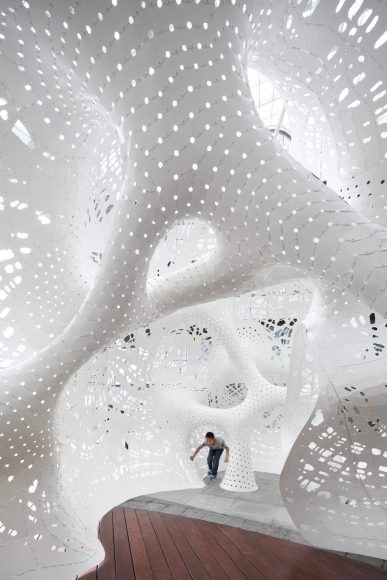


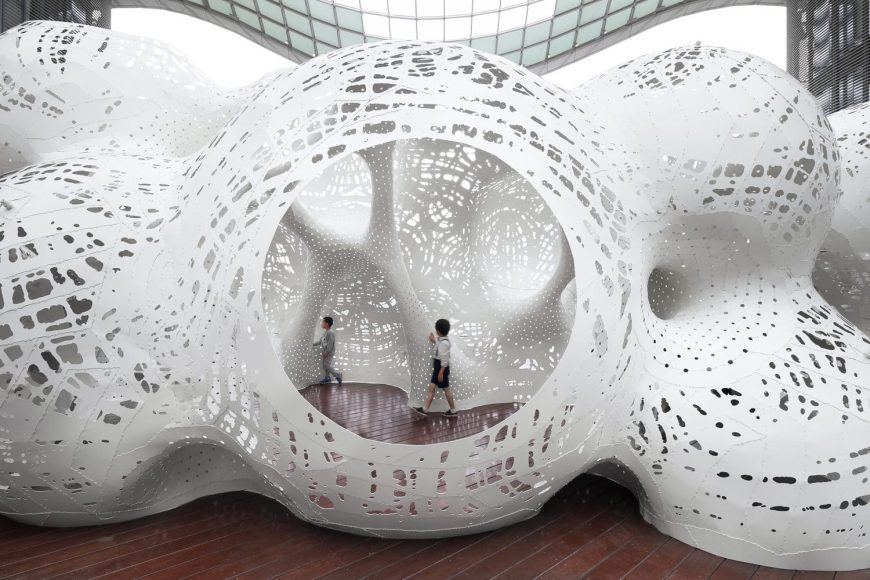

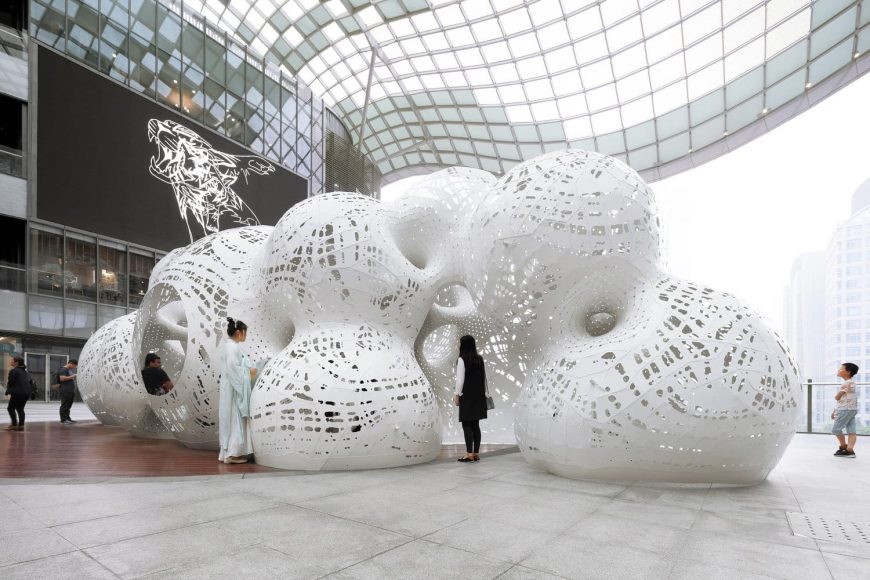

Early in 2018, French architect Marc Fornes and his studio THEVERYMANY created the white aluminum installation art titled Boolean Operator for the Jinji Lake Biennale. Featuring a porous curved structure with thousands of perforations, the work generates dynamic light-shadow interplay, its name derived from the Boolean operations concept in computer science.

Key highlights include three aspects:
1. Spatial Experimentation
The double-curved walls blur interior and exterior boundaries, allowing visitors to navigate an immersive, scale-less space. The aluminum skin’s dense perforations create starlike light projections that shift with sunlight angles, forming a real-time “light theater.”
2. Technical Innovation
Parametric design produced over 6,000 unique aluminum components, achieving millimeter-level assembly precision. The cantilevered structure—thinnest at just 3mm—pushes lightweight construction limits.

3. Interactive Philosophy
The installation encourages exploratory engagement: curved pathways form non-directional routes, prompting self-guided spatial discovery. By eliminating conventional shadow cues, the design forces reliance on tactile and kinetic perception to interpret dimensions.
This work extends THEVERYMANY’s “architecture-as-experience” ethos, earning a 2025 A+ Architecture Award nomination in the Experimental category. Its significance lies in merging digital fabrication with artistic perception to redefine participatory boundaries in public art.

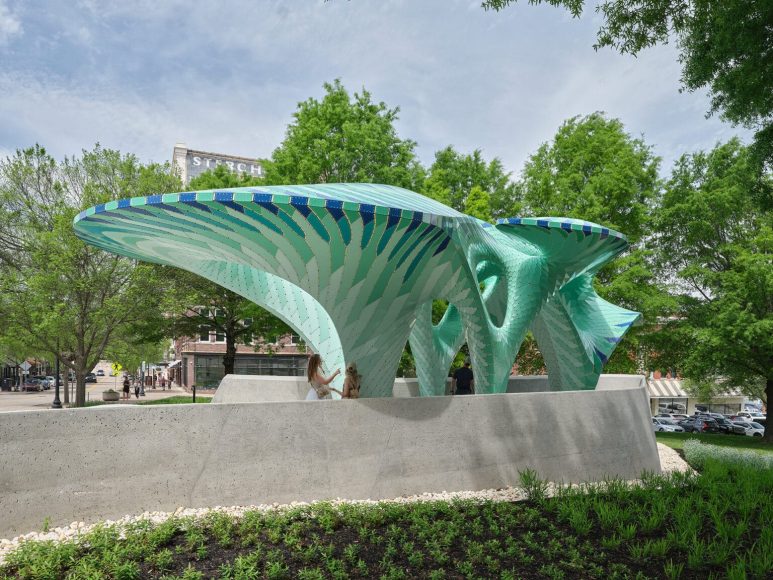
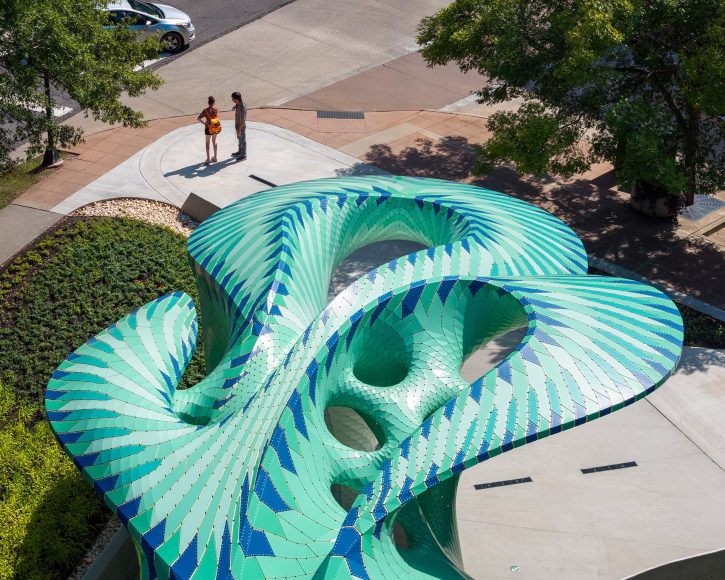
In Knoxville, Tennessee’s “Cradle of Country Music Park,” an astonishing sculptural installation named “Pier 865” has become a new urban landmark. Designed by Marc Fornes/THEVERYMANY, this work captivates attention with its unique futuristic style and exquisite craftsmanship.
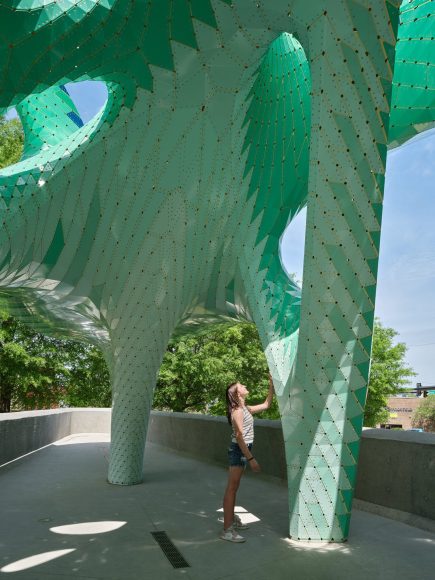
The most striking feature of this sculpture lies in its intricate construction method. The designer employed tens of thousands of meticulously painted independent aluminum components, assembled through precise calculations to create a flowing organic form. These aluminum pieces combine with pixel-like precision, ultimately presenting a marvelous visual effect that resembles both extraterrestrial flora and reptilian creatures.

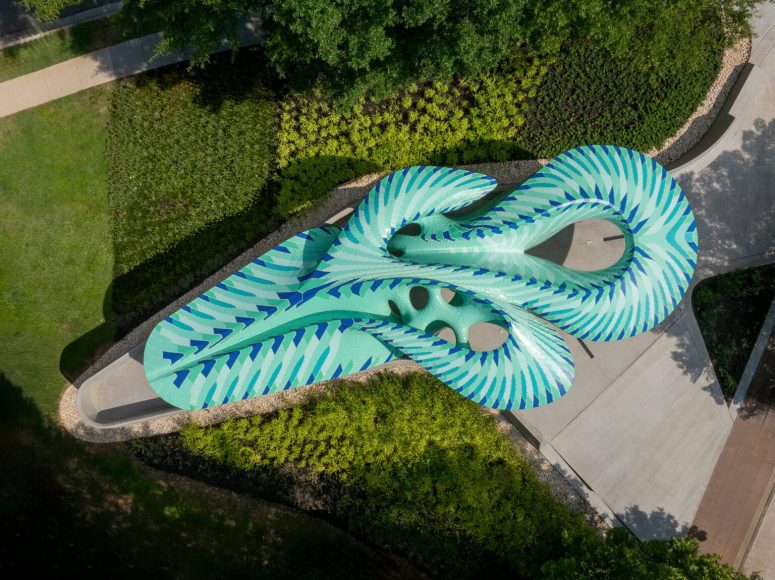
In terms of color design, the sculpture adopts a gradient green palette that harmonizes perfectly with the park’s natural surroundings. Viewed from the ground, it appears as an exotic plant emerging from the concrete; while from above, it reveals a dynamic reptilian form. This multi-perspective visual experience offers observers fresh impressions from every angle.
As a public artwork connecting Knoxville’s Old City and Theater District, “Pier 865” possesses not only aesthetic value but also practical functionality. It serves both as a resting spot for visitors and an excellent vantage point for cityscape viewing. This sculpture continues Marc Fornes’ exploration of high-tech, large-scale installation art, showcasing the perfect fusion of digital design and physical construction.

Through this work, the designer successfully introduces digital-era aesthetics into public spaces, adding a touch of futurism to Knoxville’s urban landscape.
All photographs were taken by Steve Kroodsma and Keith Isaacs, shared with authorization from Marc Fornes/THEVERYMANY.