
On November 8, 2025, the Power Station of Art (PSA) welcomed the grand opening of the 15th Shanghai Biennale. Titled “Does the flower hear the bee?”, this artistic event will run until March 31, 2026, presenting a sensory exploration that transcends species boundaries. The exhibition is curated by Chief Curator Kitty Scott, along with Co-curators Daisy Desrosiers and Xue Tan.
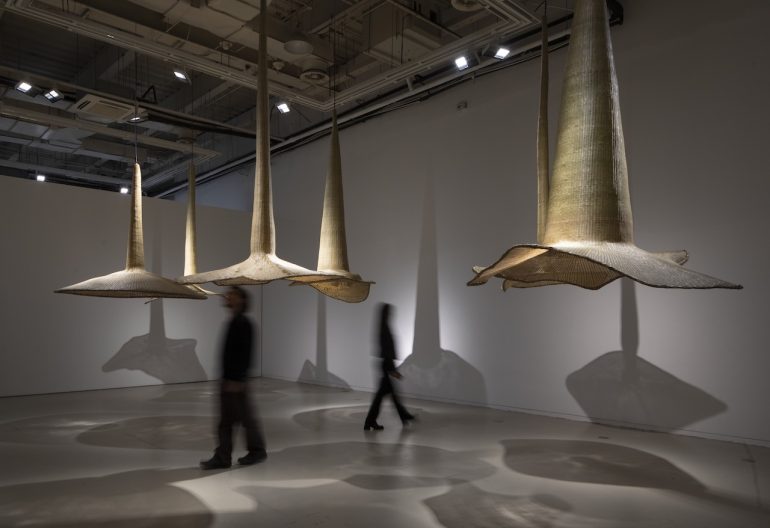
Featured: Tania Candiani, Prologue ll. Resonant Blossoms, 2025, metal and bamboo stands with speakers. Courtesy of the artist and Vermelho Gallery. Image courtesy of Power Station of Art.
From Natural Phenomenon to Philosophical Inquiry
The theme, “Does the flower hear the bee?”, originates from a fascinating natural phenomenon. Chief Curator Kitty Scott explained: “We have long known now that when bees gather, they communicate and share knowledge with each other. We are only just recognizing that this network of communication extends even further.
It turns out that flowers too are gathering information, and we now appreciate that they ‘hear’ the vibration of honeybee wings, which causes them to secrete a sweeter nectar in their presence” .
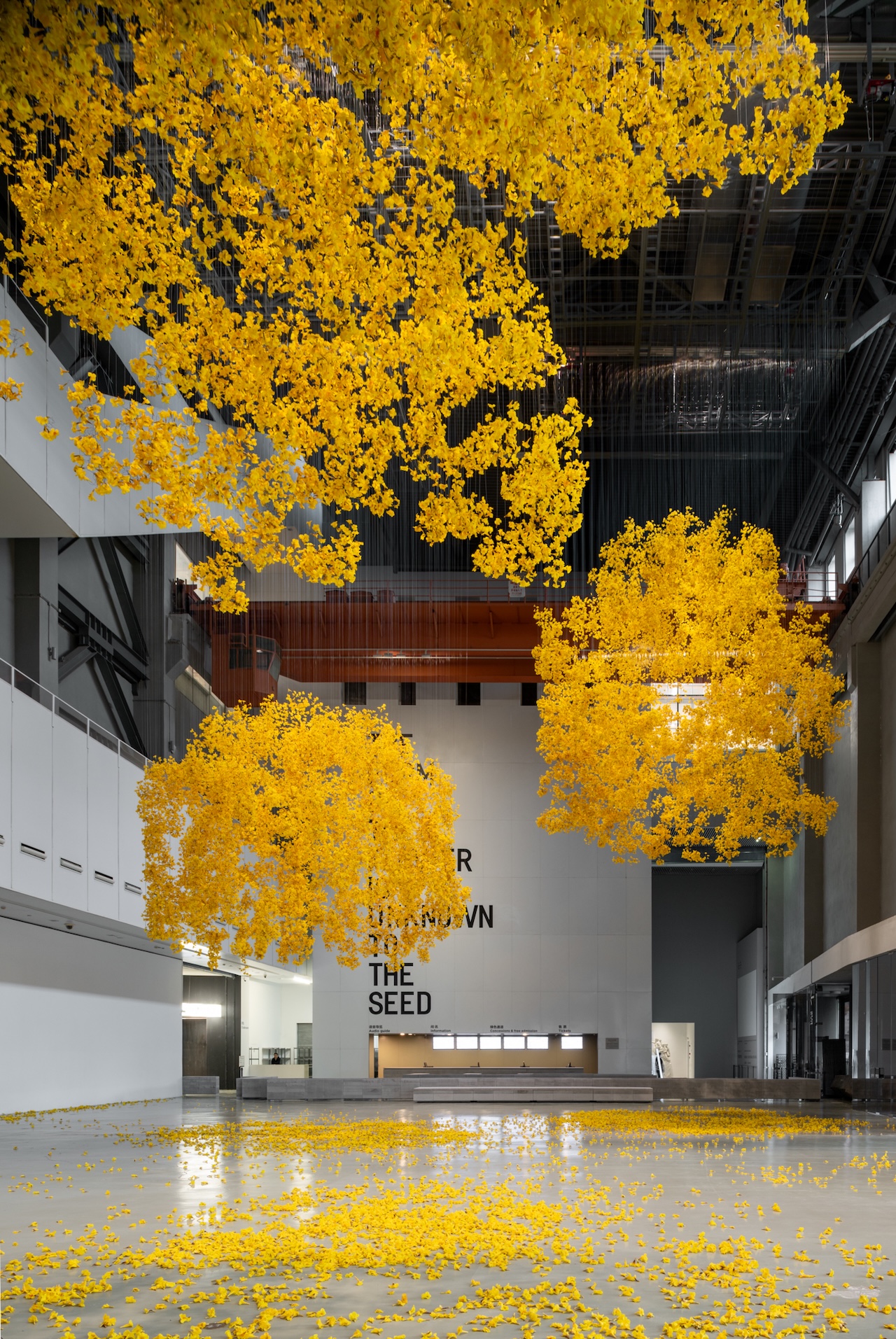
Allora & Calzadilla, Penumbra and Phantom Forest at the 15th Shanghai Biennale, Does the flower hear the bee?, 2025, Power Station of Art. ©Allora & Calzadilla. Courtesy of the artist, Lisson Gallery, Galerie Chantal Crousel, and Kurimanzutto. Image courtesy of Power Station of Art.
This discovery inspired the curatorial team to ponder deeper questions. They stated: “We live in a moment of great uncertainty and global emergency that has given rise to a widespread sense of disorientation. Our world is transforming at a pace that eludes our capacity for comprehension, leaving us feeling bewildered and uncertain.
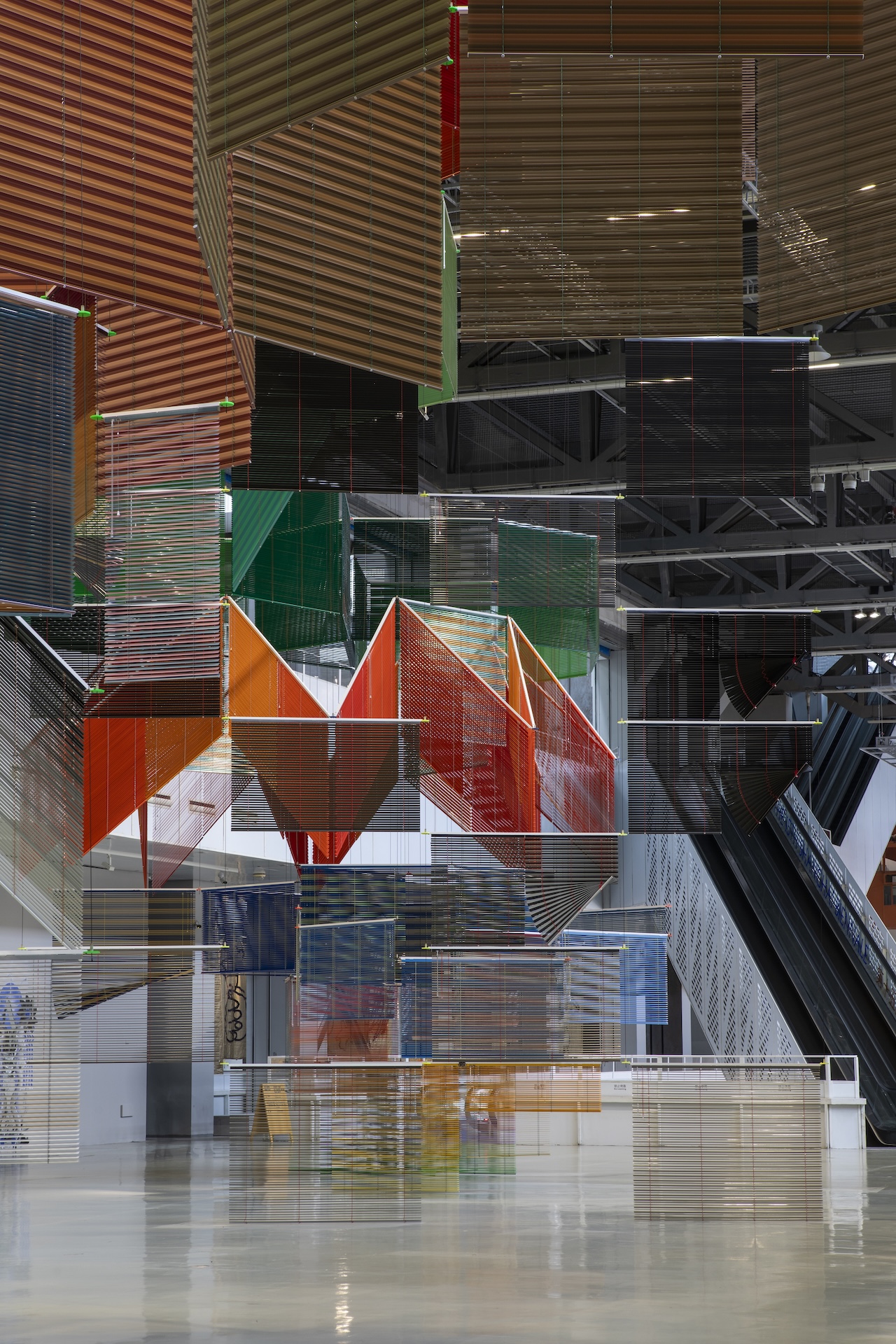
Haegue Yang, Accommodating the Epic Dispersion – On Non-Cathartic Volume of Dispersion, 2012, aluminum venetian blinds, powder-coated aluminum hanging structure, steel wire rope. Courtesy of the artist. Image courtesy of Power Station of Art.
If a return to the past is impossible, art offers us potential pathways out of despair and malaise, helping us to find emergent forms-of-life and new modes of sensorial communication amid this instability” .
After extensive dialogue with artists, curators, intellectuals, musicians, poets, scientists, and writers, the theme “Does the flower hear the bee?” was ultimately established.
The exhibition aims to convey a core idea: “much depends on our capacity to sense the world around us and attune ourselves to its diverse array of intelligences. Its hopeful vision rests on art’s ability to orient us towards an unknown future”.
Exhibition Scale and Artist Lineup
This edition of the Biennale is substantial in scale, featuring over 250 works by 67 individual artists and collectives from China and around the world, including 16 from China, with over 30 works being commissioned or newly produced .
The list of participating artists is star-studded, including internationally renowned figures like Francis Alÿs, Theaster Gates, Hao Liang, Ho Tzu Nyen, Huang Yongping, and Rirkrit Tiravanija, as well as mainstays of Chinese contemporary art such as Chen Ruofan, Cheng Xinhao, Hu Xiaoyuan, Shao Fan, and Zhou Tao.
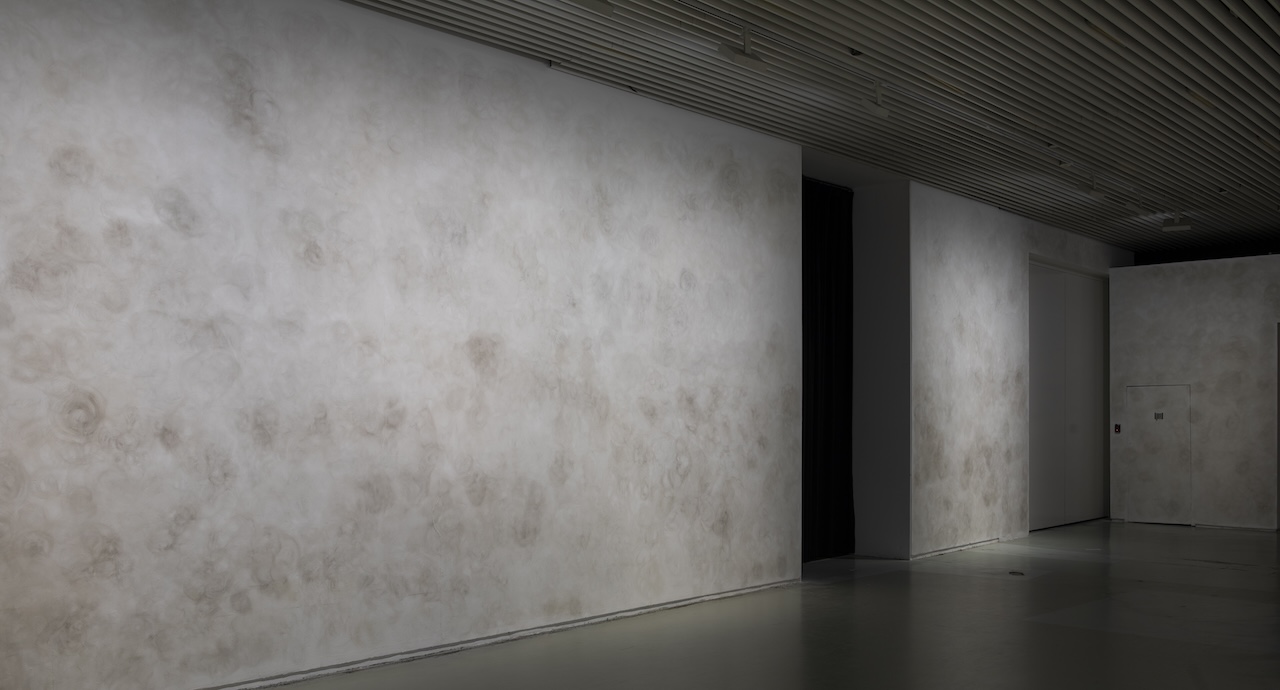
Audie Murray, To Make Smoke, 2025, smudge remnants, water. Courtesy of the artist. Image courtesy of Power Station of Art.
It is worth noting that some artists’ works will be exhibited across multiple venues. For instance, Maxime Cavajani and Theaster Gates participate in the Biennale’s City Project at the Jia Yuan Hai Art Museum.
The works of Rirkrit Tiravanija, Chen Ruofan, and Zhou Tao are on display at both the Power Station of Art and the Biennale’s City Project at the Jia Yuan Hai Art Museum.
A Garden-Like Viewing Experience
The design takes its cue from gardens—not as decoration, but as a spatial principle. The exhibition unfolds as an open landscape—a space to wander through rather than move along.
Artworks seed throughout the Power Station of Art—anchored in the grand hall, threaded through circulation paths, tucked into enclosed rooms and gallery spaces.
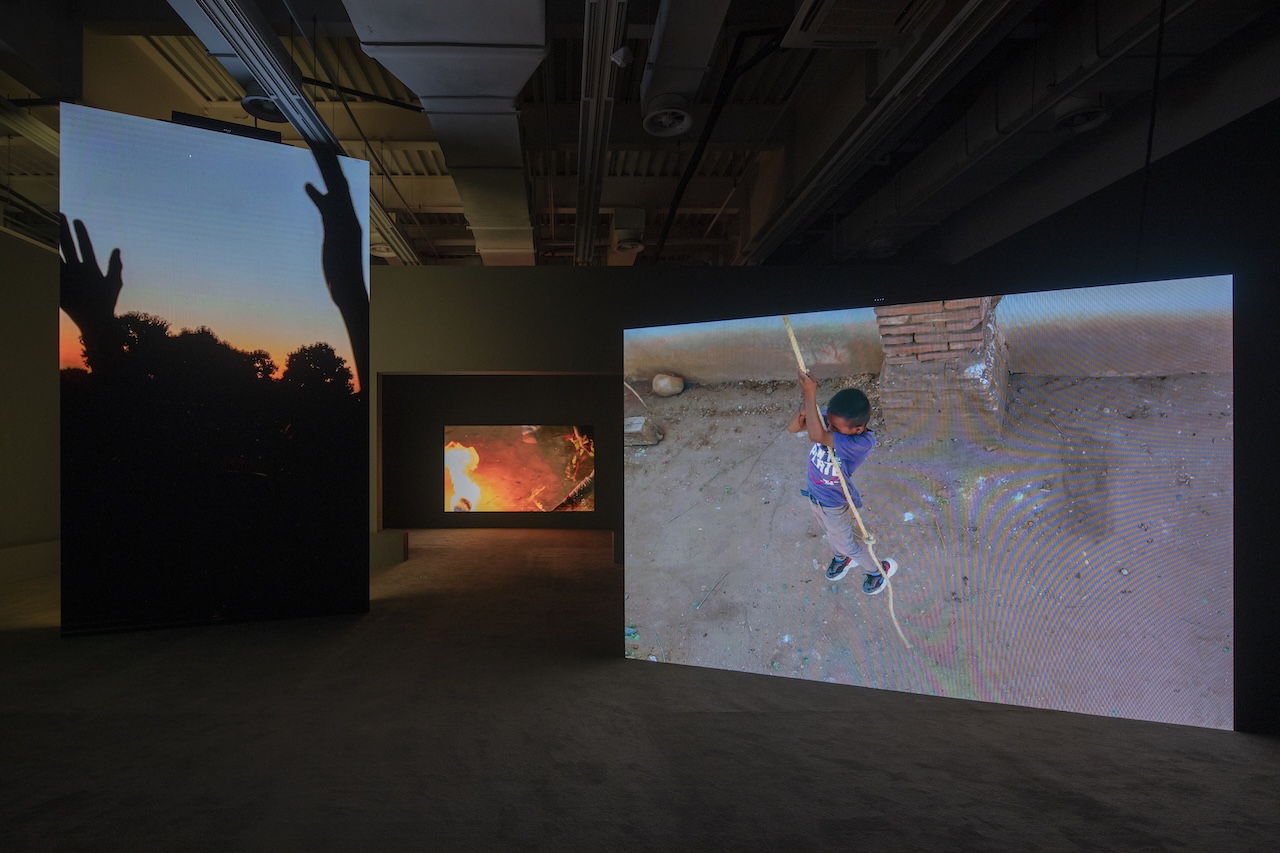
Installation view of Francis Alÿs, Children’s Game #30: lmbu, D.R.Congo, Children’s Game #52: Boy and Bell, Mexico, and Children’s Game #44: Uárhukua, Mexico at the 15th Shanghai Biennale Does the flower hear the bee?, 2025, Power Station of Art. All works courtesy of the artist. Image courtesy of Power Station of Art.
Like rockwork in a garden that shapes how you see the scenery, these blocks offer different vantage points for viewing the artworks. They are utilitarian and designed for a second life: after the exhibition, they can be upcycled rather than discarded.
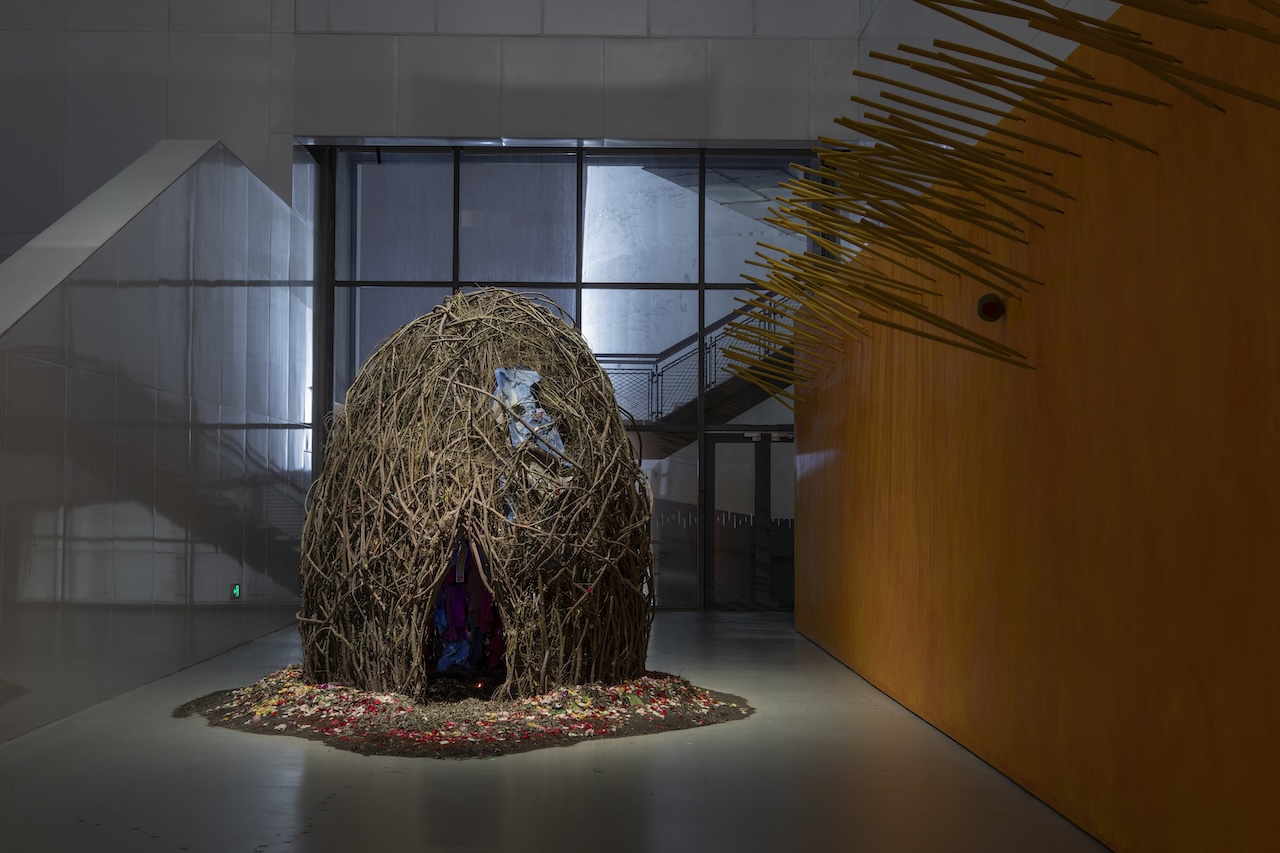
Left: Kosen Ohtsubo, Linga Shanghai, 2025, black-coated binding wire, soil, organic mulch, weeping willow branches, winged spindle, discarded flowers, scrap metal,secondhand clothes, rebar. Courtesy of the artist. Right: Christian Kōun Alborz Oldham, Terminalia (Incense Clock), 2025, fabric cushion, incense sticks, polyurethane binder, turmeric, 125 days. Courtesy of the artist. Image courtesy of Power Station of Art.
This design philosophy is reminiscent of a Chinese scholar garden or a Japanese stroll garden, where the exhibition reveals itself progressively. As you move through, sightlines shift and new compositions emerge. There is no prescribed route, only invitation.
A Deep Dialogue Between Art and the City
The City Projects of the 15th Shanghai Biennale aim to have a generative momentum. Beginning at PSA, the projects progressively summon, relocate, displace, and spread into multiple landscapes—from garden fences in urban neighborhoods (e.g., VILLA tbh) to open fields on the outskirts (Jia Yuan Hai Art Museum), from carefully cultivated bonsai in botanical gardens (Shanghai Botanical Garden) to native grasses growing freely on balcony gardens (klee klee)—and over the course of the exhibition, will reach further corners of Shanghai.
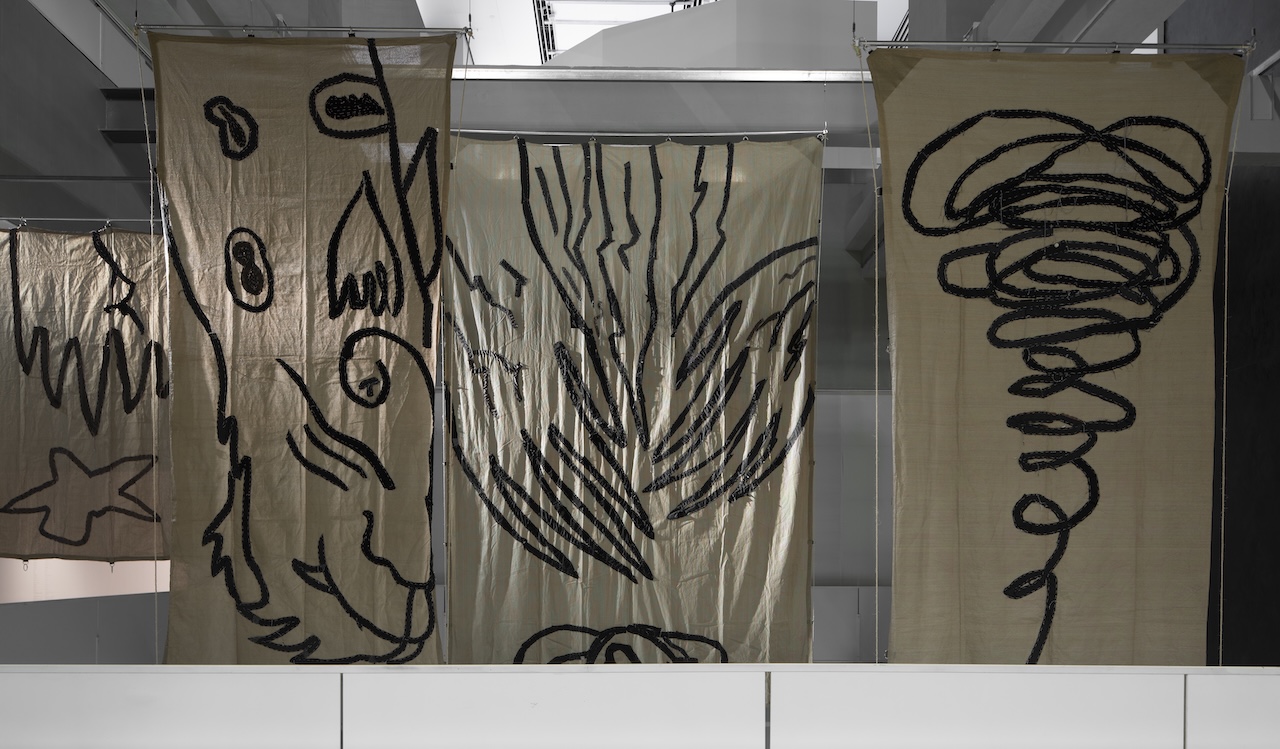
Abraham González Pacheco, Consigna al viento (Windborne Message), 2024, 10 pieces of high density polyethylene shade cloth with hand-stitched fabric patterns on the surface. Courtesy of the artist and Campeche. Image courtesy of Power Station of Art.
These back-and-forth passages resemble successive and affective “bee paths.” As the public experiences art in different places, every pause, touch, and conversation helps catalyze the mingling of art and everyday rhythms — eventually, through perception, movement, and encounter, one quietly attunes to those “moments of abundance”.
Highlights of the City Projects
The Jia Yuan Hai Art Museum will present “Does the flower hear the bee? (Extended Version),” featuring works by Maxime Cavajani, Chen Ruofan, Theaster Gates, Liu Shuai, Rirkrit Tiravanija, and Zhou Tao.
Designed by Japanese architect Tadao Ando with a philosophy of dialogue between architecture, nature, and the human, the museum becomes a site where the works of these six artists form another kind of resonance with land, architecture, light, and sound.
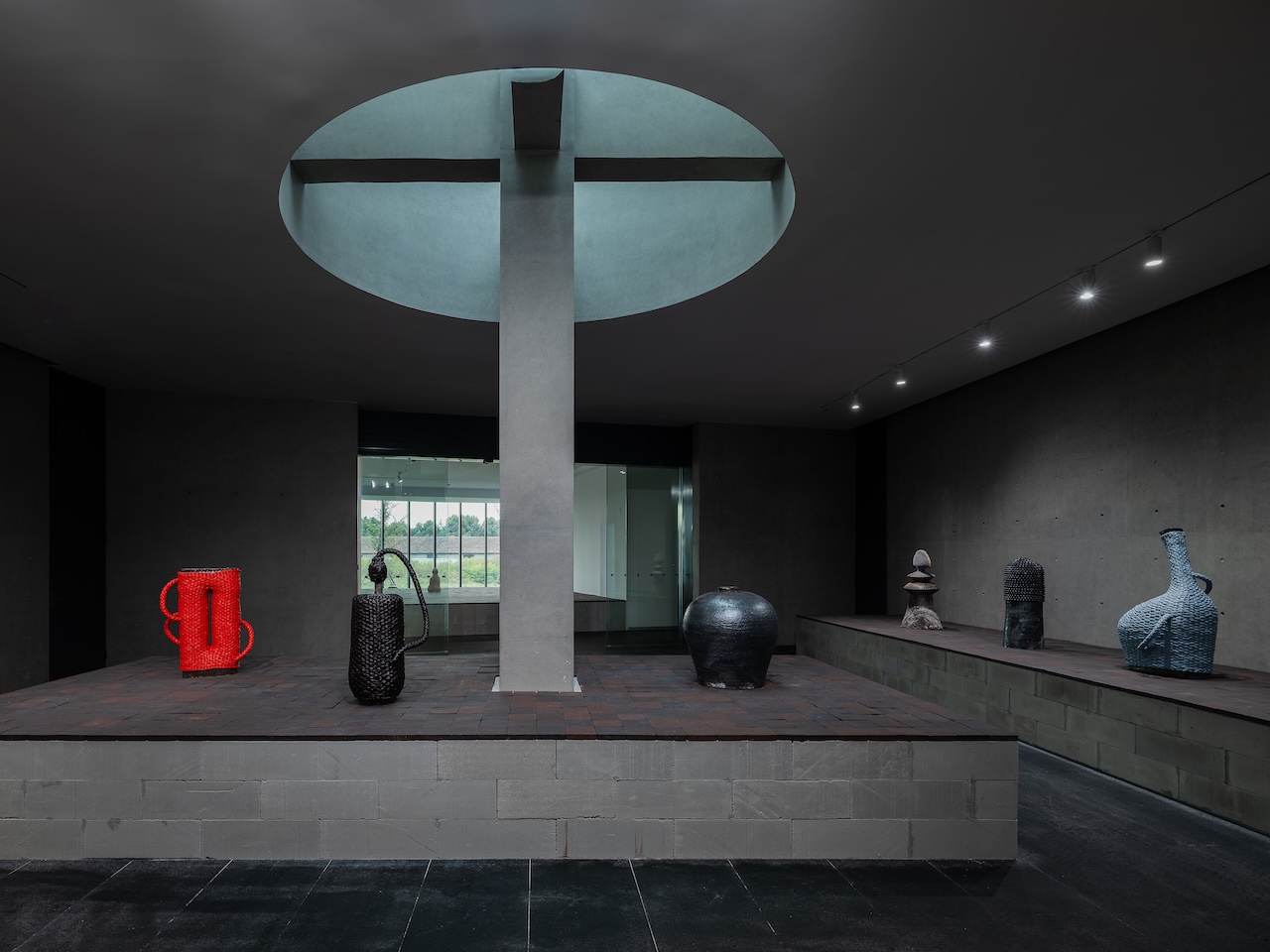
Theaster Gates, Composite Meditation, 2025, 4 pieces wood-fired stoneware with manganese glaze; 3 pieces wood-fired stoneware and leather; 1 stoneware with glaze; bricks. Courtesy of the artist. Image Courtesy of Jia Yuan Hai Art Museum.
At VILLA tbh, artist Liu Shuai presents “Slide, Then Soar!”, a commission for the 15th Shanghai Biennale. In a small, hovering form, it poetically engages the garden-world’s everyday nature—kites collaged from plants, and bamboo reeds punctured by bees and are repurposed as an instrument. Through a human–nature collaboration, the work responds to the Biennale’s query in “Does the flower hear the bee?”.
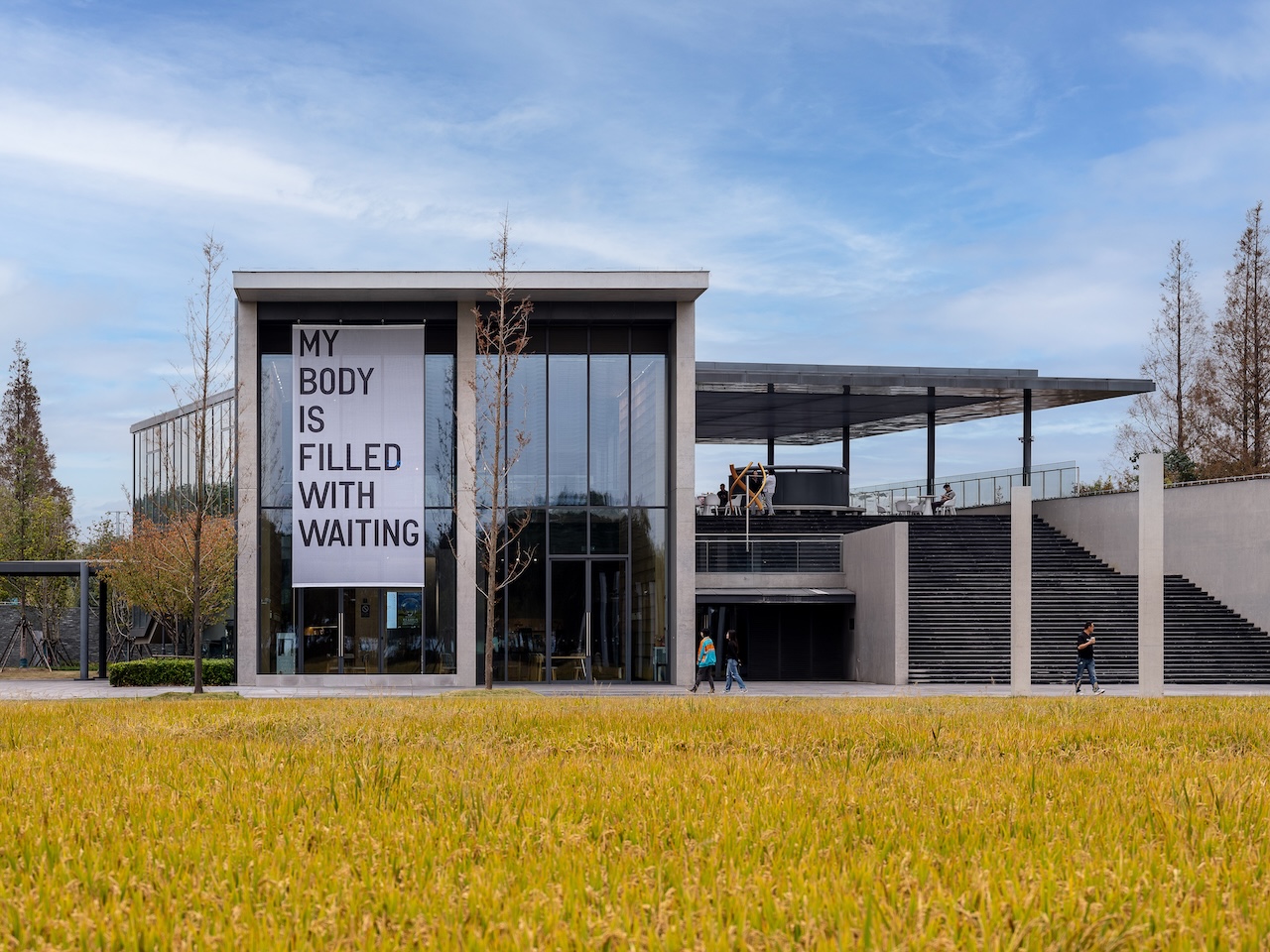
Rirkrit Tiravanija, untitled 2025 (my body is filled with waiting), 2025, digital print on canvas. Courtesy of the artist. Image Courtesy of Jia Yuan Hai Art Museum.
The Penjing Garden of the Shanghai Botanical Garden will host a site-specific performance by Ami Yamasaki, continuing her exploration of acoustic space and reciprocal listening. Treating the human voice as a method of locating oneself in the world, and the body as a vessel that resonates with space, the artist situates herself through singing, listening, and echo, gradually dissolving the subject–site boundary and inviting audiences to co-establish new sensitivities.
The Profound Significance of the Exhibition
The 15th Shanghai Biennale, “Does the flower hear the bee?”, is more than just an art exhibition; it is a profound reflection on perception, communication, and coexistence. Through the artworks, the exhibition invites viewers to re-examine their relationship with the surrounding world, particularly with the non-human world.
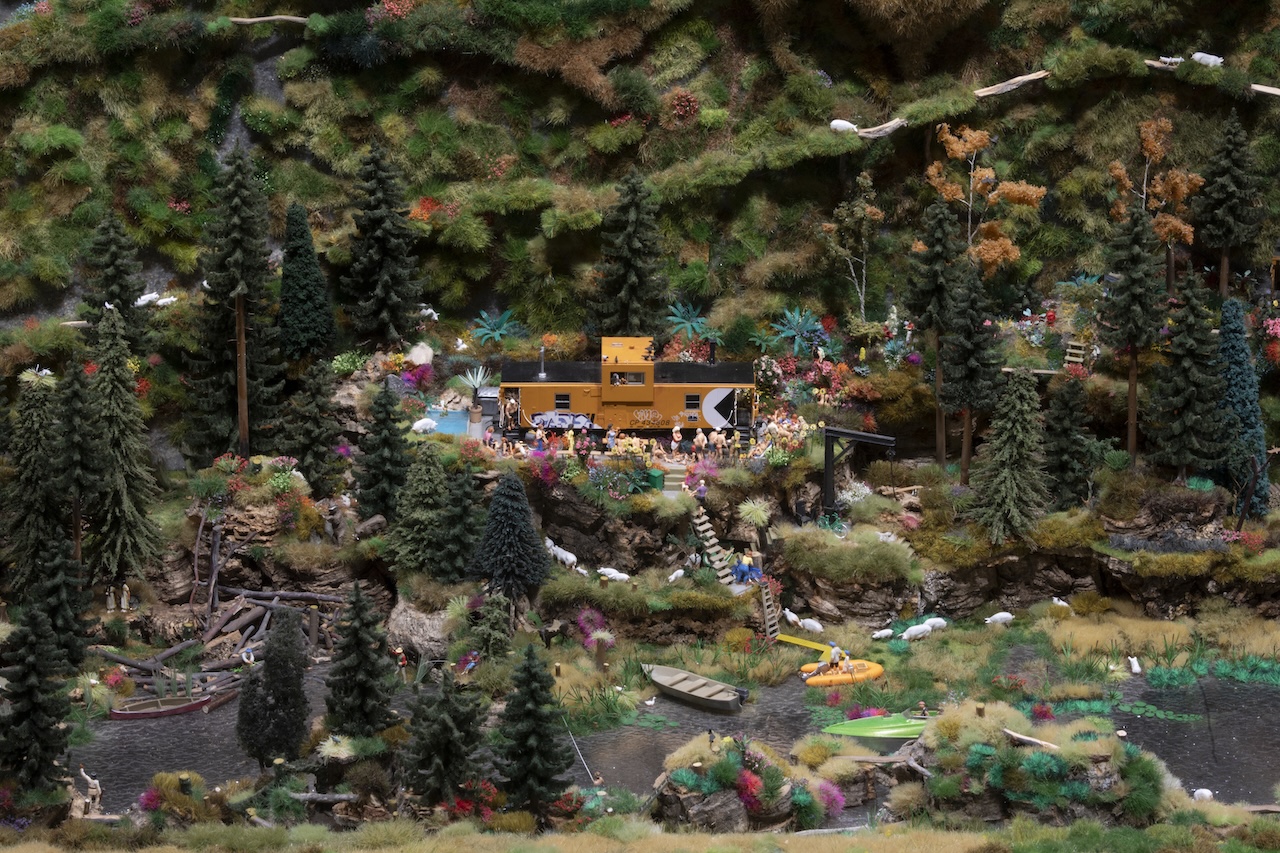
Kim Adams, Arrived (Formerly Known as Pig Mountain), 2014-2025, HO 1/87 scale miniature models, faux rock, landscape materials, cork bark, powdered pigments. Courtesy of the artist and Hunt Gallery. Image courtesy of Power Station of Art.
Like the flower that “hears” the bee’s wings, the 15th Shanghai Biennale aims to operate at the intersection of differing models of intelligence, both human and nonhuman. It is based on the belief that recent art provides us with a privileged space for such investigations, offering an embodied and interconnected sphere in which communities may form stronger bonds with “the more-than-human world”.
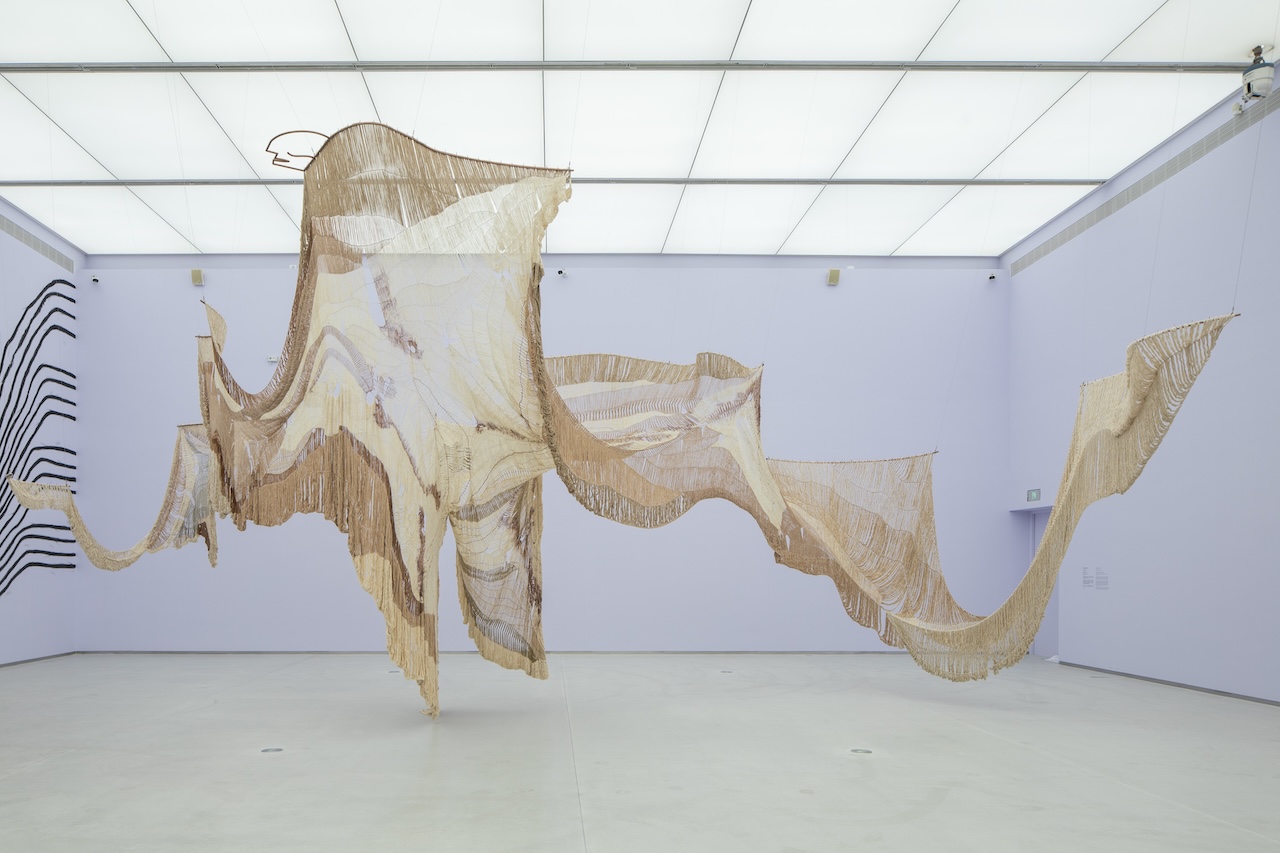
Cristina Flores Pescorán, Abrazar el sol (Embrace the Sun), 2023-2024, native Peruvian cotton,threads dyed in purple corn, copper rods. Commissioned by the Biennale of Sydney and the Fondation Cartier pour l’art contemporain. Courtesy of the artist. Image courtesy of Power Station of Art.
The curatorial team hopes that every visitor, like the flower, will recognize that so much depends on hearing the bee. This “hearing” refers not only to auditory perception but to an all-encompassing sensory openness and spiritual resonance. In an era full of uncertainties, art offers us potential pathways out of despair and malaise, helping us to find emergent forms-of-life and new modes of sensorial communication.
Conclusion
The 15th Shanghai Biennale, “Does the flower hear the bee?”, is an artistic exploration that transcends species boundaries and a philosophical inquiry into perception and communication. Through over 250 works by 67 artists and collectives, the exhibition invites the audience to open all senses to “hear” the sounds usually ignored and to feel the existences often overlooked.
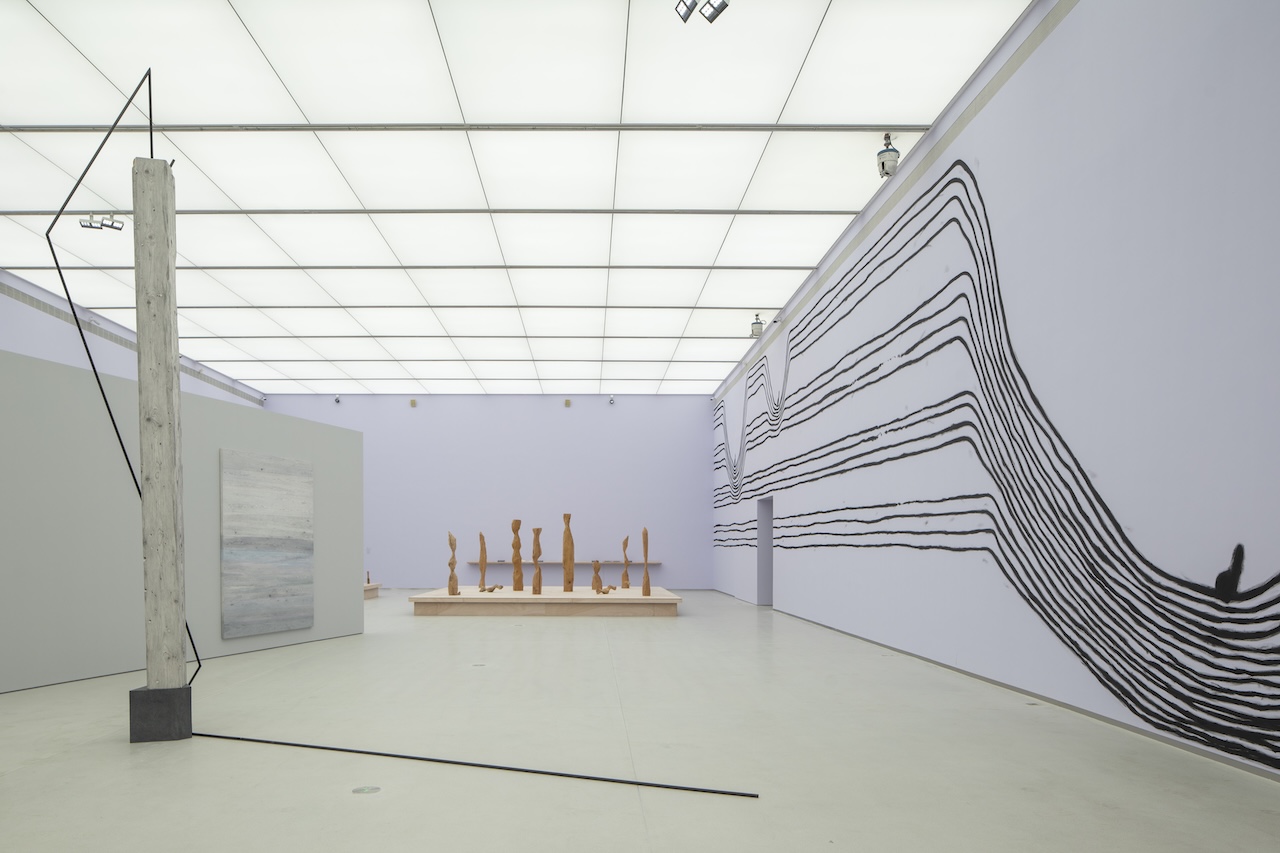
Installation view of the 15th Shanghai Biennale Does the flower hear the bee?, 2025, Power Station of Art. Image courtesy of Power Station of Art.
The exhibition not only showcases the diversity and innovation of contemporary art but, more importantly, it proposes a new worldview: humans are not the only intelligent life on Earth; we are surrounded by various forms of intelligence and perception. Only by learning to listen to and respect these non-human intelligences can we find new ways of survival in this challenging era.
As the exhibition title suggests, if flowers can hear the buzzing of bees, can we humans also hear the calls of the world around us? The 15th Shanghai Biennale offers a hopeful answer: through art, we can relearn how to perceive the world and how to coexist harmoniously with all beings. This is not only an exploration of art but also a profound reflection on the future of human life.
Visitor Itineraries
Visiting an exhibition is a profound dialogue with art and ideas. Choosing different paths yields entirely different experiences.
For the 15th Shanghai Biennale, “Does the flower hear the bee?”, we have outlined three distinct visitor itineraries, each with a unique focus, to help you find your own rhythm and discoveries within this “garden.” Welcome to send “PSA15” in the “artthat” dialog box of WeChat public account get the e-brochure for free.
Source: Power Station of Art, the article combines AI generation for reference only.